Spanish is full of funny sayings that make people laugh and share life lessons. Some use animals, food, or everyday problems to explain human behavior in a clever way.
If you are looking for spanish sayings funny, this guide has playful expressions, witty phrases, and humorous Spanish lines with simple English meanings.
You can use them with friends, add them to social media captions, or learn more about Spanish-speaking culture.
Each saying includes an English meaning so you can understand the joke. You will also find useful tips for using these expressions in daily chats.
Quick Answer: What Are Funny Spanish Sayings?
Funny Spanish sayings are playful expressions that use humor to describe daily life, relationships, mistakes, and human behavior. Many are well-known Spanish proverbs, while others are casual phrases or creative lines. For example, “Más vale tarde que nunca” means “Better late than never.” These expressions can make conversations, jokes, and social media captions more fun.
1. Funny Spanish Sayings About Life

Life can be messy, surprising, and full of small mistakes. These Spanish expressions use humor and simple wisdom to describe everyday situations.
- Más vale tarde que nunca. — Better late than never.
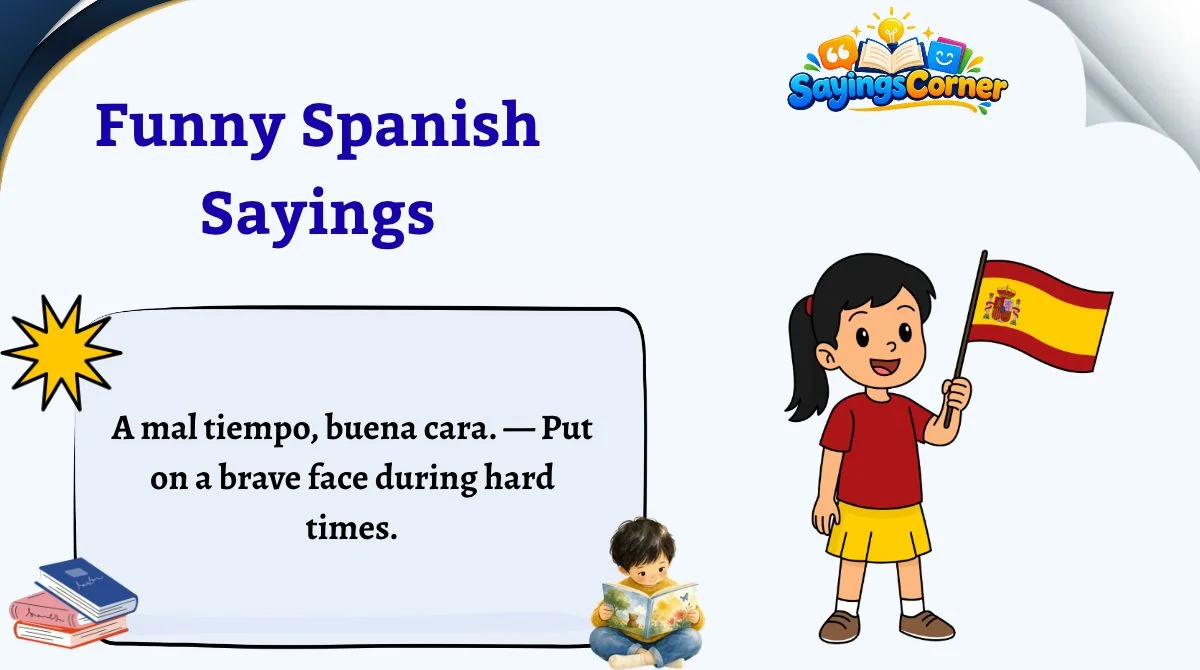
- A mal tiempo, buena cara. — Put on a brave face during hard times.
- No hay mal que por bien no venga. — Every bad situation may lead to something good.
- El que mucho abarca, poco aprieta. — If you try to do too much, you may do little well.
- Cada loco con su tema. — Everyone has their own strange interests.
- De los errores se aprende. — We learn from our mistakes.
- La vida es corta, sonríe mientras tengas dientes. — Life is short, so smile while you still have teeth. This is a playful line, not a traditional proverb.
- Al mal paso, darle prisa. — Get an unpleasant task over with quickly.
- No todo lo que brilla es oro. — Not everything that shines is gold.
- El que no arriesga, no gana. — Nothing is gained without taking a risk.
These sayings work well when talking about bad days, missed chances, or funny life lessons. They can also make a serious message feel lighter.
2. Funny Spanish Sayings About Food
Food plays a big role in Spanish-speaking life, and many expressions use it to share advice. Some are clever, while others are funny because they compare food with people.
- A falta de pan, buenas son tortas. — When bread is missing, other food will do.
- Al pan, pan, y al vino, vino. — Call things what they really are.
- Dar calabazas a alguien. — To reject someone romantically.
- Estar como un queso. — To be very attractive.
- Ser pan comido. — To be very easy.
- Importar un pepino. — To care very little about something.
- Me importa un pimiento. — I do not care at all.
- No comerse ni un rosco. — To get no success, often in romance or competition.
- Tener mala leche. — To have a bad temper or act in a nasty way.
- Ir pisando huevos. — To move very slowly or carefully, as if walking on eggs.
These expressions can make ordinary conversations more colorful. Keep in mind that some phrases are informal, and their exact meaning may depend on the country or situation.
3. Funny Spanish Sayings About Animals
Animals appear in many Spanish proverbs. They can represent cleverness, stubbornness, bad luck, or people who act in amusing ways.
- A caballo regalado no le mires el diente. — Do not criticize a gift.
- Perro ladrador, poco mordedor. — People who make the most threats often do the least.
- Más vale pájaro en mano que ciento volando. — A sure thing is better than many uncertain hopes.
- En boca cerrada no entran moscas. — Keeping quiet can prevent trouble.
- Cría cuervos y te sacarán los ojos. — Be careful whom you help; some may turn against you.
- Aunque la mona se vista de seda, mona se queda. — Fancy clothes cannot change someone’s nature.
- Cuando el gato no está, los ratones bailan. — People behave freely when the boss is away.
- A otro perro con ese hueso. — Tell that excuse to someone else; I do not believe you.
- Buscarle tres pies al gato. — To make something more complicated than it needs to be.
- Llevarse como el perro y el gato. — To fight or argue like cats and dogs.
Animal sayings are easy to remember because they create funny pictures in your mind. Use them when a friend makes a silly excuse or two people cannot stop arguing.
4. Funny Spanish Sayings About Love and Dating
Love can bring joy, confusion, and plenty of awkward moments. These expressions help you talk about attraction, rejection, and relationships with a playful touch.
- El amor es ciego. — Love is blind.
- Contigo, pan y cebolla. — With you, even bread and onions are enough.
- Dar calabazas. — To turn someone down.
- Estar colado por alguien. — To have a big crush on someone.
- Tirar los tejos. — To flirt with someone.
- Buscar tu media naranja. — To look for your perfect match.
- Quien bien te quiere, te hará llorar. — Someone who truly cares may sometimes tell you difficult truths.
- Amor de lejos, felices los cuatro. — A cynical joke suggesting that long-distance relationships can involve other partners.
- Del amor al odio hay un paso. — The distance between love and hate can be small.
- Donde hubo fuego, cenizas quedan. — Old feelings may remain after a relationship ends.
Some of these expressions are romantic, while others are sarcastic. The long-distance relationship saying, for example, is a joke rather than good relationship advice.
5. Funny Spanish Sayings About Laziness and Work
Work, chores, and responsibilities are perfect topics for humor. These sayings can describe people who avoid effort or remind us that actions matter more than talk.
- No dejes para mañana lo que puedas hacer hoy. — Do not put off until tomorrow what you can do today.
- Del dicho al hecho hay mucho trecho. — There is a big gap between saying something and doing it.
- Mucho ruido y pocas nueces. — Lots of noise, but very little result.
- El que espera, desespera. — Waiting too long can drive you crazy.
- A quien madruga, Dios le ayuda. — The early bird gets the worm.
- Trabajar como un burro. — To work like a donkey.
- Estar hasta las narices. — To be fed up with something.
- No pegar golpe. — To do no work at all.
- Tomarse las cosas con calma. — To take things easy.
- Quedarse de brazos cruzados. — To sit back and do nothing.
These phrases fit office jokes, school conversations, and chats about household chores. For example, “No pego golpe hoy” can be a casual way to say you are doing no work today.
6. Funny Spanish Sayings About Money
Money can cause stress, but Spanish expressions often use it to explain choices, luck, and spending habits.
- El dinero no crece en los árboles. — Money does not grow on trees.
- Lo barato sale caro. — Cheap things can end up costing more.
- Poderoso caballero es don Dinero. — Money has great power.
- Tirar la casa por la ventana. — To spend a lot or celebrate in a big way.
- Estar sin blanca. — To have no money.
- Costar un ojo de la cara. — To cost an arm and a leg.
- Ahorrar para los días de vacas flacas. — To save for hard times.
- Gastar más de lo que se gana. — To spend more than you earn.
- El dinero va y viene. — Money comes and goes.
- No tener ni un duro. — To have no money at all; duro is an older Spanish currency term still used in some expressions.
These sayings are useful when discussing shopping, saving, or someone who spends too much. Some expressions, such as estar sin blanca, are more common in Spain than in other Spanish-speaking regions.
7. Funny Spanish Sayings About Friends and People
Friends often know how to make us laugh, but they can also test our patience. These expressions describe human habits in short, memorable ways.
- Dime con quién andas y te diré quién eres. — Tell me who your friends are, and I will tell you who you are.
- Cada oveja con su pareja. — Everyone should find someone who suits them.
- El que se pica, ajos come. — If you get offended, perhaps the comment hit a nerve.
- No hay peor ciego que el que no quiere ver. — No one is as blind as someone who refuses to see the truth.
- De tal palo, tal astilla. — Like father, like son; children often resemble their parents.
- Quien tiene boca se equivoca. — Anyone who speaks can make mistakes.
- A palabras necias, oídos sordos. — Ignore foolish words.
- Dios los cría y ellos se juntan. — Birds of a feather flock together.
- El mundo es un pañuelo. — It is a small world.
- Para gustos, los colores. — Everyone has different tastes.
These sayings are useful when friends tease each other or when you meet someone who shares your strange habits. Some are wise, while others can sound teasing depending on your tone.
8. Short and Silly Spanish Phrases for Everyday Chats
Not every funny expression needs to be a traditional proverb. These common phrases and playful lines are useful for casual chats, jokes, and social media posts.
- ¡Qué lío! — What a mess!
- ¡Menudo desastre! — What a disaster!
- Estoy hecho polvo. — I am exhausted or worn out.
- ¡Vaya tela! — What a situation! Often used when something is shocking or frustrating.
- ¡Ni de broma! — Not a chance! Or, no way!
- ¡Qué fuerte! — That is unbelievable!
- Me muero de risa. — I am dying of laughter.
- Tengo un hambre que flipas. — I am incredibly hungry. This is very informal Spanish, especially in Spain.
- Estoy más perdido que un pulpo en un garaje. — I am as lost as an octopus in a garage.
- Tengo más sueño que un koala. — I am sleepier than a koala. This is a playful, creative comparison rather than a fixed traditional saying.
Use these phrases with people you know well. Informal expressions can sound natural among friends but may not fit a formal meeting or professional email.
9. Funny Spanish Sayings for Instagram Captions
A good caption should be short, clear, and easy to remember. These sayings and playful lines can add humor to photos, travel posts, and everyday updates.
- La vida es mejor con café. — Life is better with coffee.
- Menos drama y más siesta. — Less drama and more naps.
- Hoy no estoy para nadie. — I am not available for anyone today.
- Sonríe, que la vida vuela. — Smile because life flies by.
- Mucho sol, poca preocupación. — Lots of sunshine, few worries.
- Viviendo la vida a mi manera. — Living life my own way.
- No soy perfecto, pero soy divertido. — I am not perfect, but I am fun.
- Si la vida te da limones, pide sal. — If life gives you lemons, ask for salt. This is a playful variation, not a standard Spanish proverb.
- Con sueño, pero con estilo. — Sleepy, but stylish.
- Mi plan favorito es no tener plan. — My favorite plan is having no plan.
These captions are best for lighthearted posts. Some are creative Spanish lines rather than established sayings, so they should not be presented as ancient proverbs.
10. Funny Spanish Sayings About Bad Luck and Mistakes
Everyone makes mistakes, and sometimes things go wrong at the worst possible time. These sayings help describe bad luck, poor choices, and unexpected problems.
- Al perro flaco todo se le vuelven pulgas. — When someone is already struggling, more problems seem to appear.
- El que la hace, la paga. — You must face the consequences of your actions.
- A lo hecho, pecho. — Face what has been done and deal with it.
- No hay peor sordo que el que no quiere oír. — No one is as deaf as someone who refuses to listen.
- Salir de Guatemala y entrar en Guatepeor. — To escape one bad situation and end up in an even worse one. This is a wordplay expression used in some Spanish-speaking communities.
- Ir de Guatemala a Guatepeor. — To go from bad to worse.
- Tropezar dos veces con la misma piedra. — To make the same mistake twice.
- Éramos pocos y parió la abuela. — We already had enough problems, and now there is another one.
- Cuando llueve, diluvia. — When one problem happens, many more seem to follow.
- Meter la pata. — To mess up or make a mistake.
These expressions are handy when plans fail or someone makes an awkward mistake. They let you describe a problem with humor instead of sounding too serious.
A Useful Table of Funny Spanish Sayings
Here is a quick guide to some of the most useful expressions, their meanings, and when to use them.
| Spanish saying | English meaning | Best use |
|---|---|---|
| Más vale tarde que nunca | Better late than never | When someone arrives late |
| Ser pan comido | To be very easy | Talking about a simple task |
| Me importa un pepino | I do not care | Casual, informal conversations |
| Perro ladrador, poco mordedor | Big talk, little action | Describing an empty threat |
| Dar calabazas | To reject someone | Talking about dating |
| Mucho ruido y pocas nueces | Lots of talk, little result | Work or school situations |
| Estar sin blanca | To have no money | Talking about being broke |
| Meter la pata | To mess up | Admitting a mistake |
| El mundo es un pañuelo | It is a small world | Meeting someone unexpectedly |
| Éramos pocos y parió la abuela | Another problem has appeared | Complaining humorously |
Tip: Learn the meaning and the situation together. This makes each phrase easier to remember and helps you avoid using it in the wrong setting.
How to Use Funny Spanish Sayings Naturally
Learning a saying is easy. Knowing when to use it is what makes your Spanish sound more natural. Follow these simple tips.
- Learn the full meaning. Some expressions do not make sense when translated word for word. For example, dar calabazas literally mentions pumpkins, but it means rejecting someone.
- Start with short expressions. Phrases such as “¡Qué lío!” and “¡Ni de broma!” are easy to use in casual chats.
- Pay attention to tone. A phrase can sound friendly, sarcastic, or rude depending on how you say it.
- Know your audience. A joke that works with close friends may not suit a teacher, boss, or stranger.
- Check regional differences. Spanish varies across Spain, Mexico, Argentina, Colombia, and other Spanish-speaking places. Some expressions are more common in one region than another.
- Use captions carefully. If you post a Spanish saying online, include a simple translation when your audience may not understand it.
- Practice with real situations. If a task is easy, try saying “Es pan comido.” If you make a mistake, “Metí la pata” is a useful way to admit it.
- Avoid translating jokes too literally. A phrase may be funny in Spanish but sound strange in English. Focus on the intended meaning instead.
The best way to learn these sayings is to use one or two at a time. Listen to native speakers, notice how they use expressions, and practice them in simple conversations.
Frequently Asked Questions
1. What is the funniest Spanish saying?
One funny example is “Estoy más perdido que un pulpo en un garaje,” which means “I am as lost as an octopus in a garage.” It creates a silly image and describes confusion in a memorable way. It is a humorous expression, not a universal traditional proverb.
2. What is a popular Spanish saying about life?
“A mal tiempo, buena cara” is a well-known Spanish proverb. It means you should keep a positive attitude during hard times. People use it to encourage friends who face problems, setbacks, or disappointment. Its message is simple: try to stay hopeful when life gets difficult.
3. How do you say “I don’t care” in Spanish in a funny way?
You can say “Me importa un pepino” or “Me importa un pimiento.” Both mean that you do not care about something. These expressions are informal, so they work best with friends or in casual conversations rather than serious or professional situations.
4. Are funny Spanish sayings the same in every Spanish-speaking country?
No. Spanish expressions can vary by country, region, and age group. A phrase that is common in Spain may sound unusual in Mexico or Argentina. Some proverbs are widely understood, but slang and humorous expressions often have local meanings or different levels of formality.
5. Can I use funny Spanish sayings as Instagram captions?
Yes! Short expressions such as “¡Qué lío!”, “El mundo es un pañuelo,” and “Menos drama y más siesta” can work well as captions. Check the meaning before posting, especially if the phrase is sarcastic or informal. A short English translation can also help your followers understand the joke.
Conclusion
Funny Spanish sayings make language learning more enjoyable and help you understand how people express humor in daily life.
From animal proverbs to playful food expressions, each phrase offers a new way to describe mistakes, love, work, and everyday surprises.
Start with a few simple sayings, learn their meanings, and use them in the right situations. With practice, you can make your Spanish conversations more natural, memorable, and fun.

Lucas Whitmore is a passionate writer who loves exploring funny sayings, timeless wisdom, and meaningful words about life. Through SayingsCorner, he shares memorable expressions that inspire smiles, spark reflection, and bring people closer together.