
German is known for its long words, funny expressions, and unique sense of humor.
Some funny German sayings sound strange when translated into English, but their meanings are often clever and amusing.
They can be about food, animals, work, love, friendship, and everyday life.
Some make fun of lazy people, while others teach simple lessons in a funny way. In this article, you will find 80 funny German sayings with their English meanings.
Whether you are learning German, looking for a funny caption, or simply enjoy exploring other cultures, these expressions will bring a smile to your face.
Quick Answer
Funny German sayings are amusing expressions that use humor, clever comparisons, and everyday situations. Examples include “Ich verstehe nur Bahnhof” (I only understand train station) and “Da steppt der Bär” (The bear is dancing there). These sayings are fun to learn and share with friends.
Funny German Sayings About Everyday Life
German everyday expressions can be funny because they describe normal situations in unexpected ways. These sayings are useful when talking about daily problems, silly moments, and things that happen around us.
- Ich verstehe nur Bahnhof. – I only understand train station. (I don’t understand anything.)
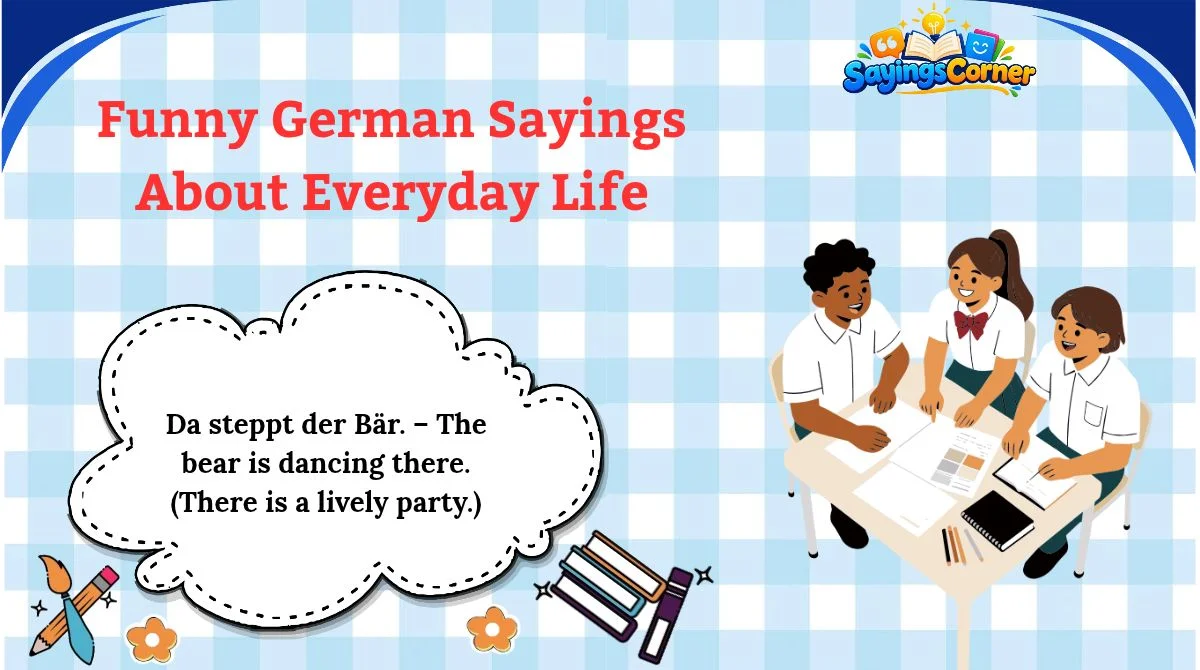
- Da steppt der Bär. – The bear is dancing there. (There is a lively party.)
- Das ist nicht mein Bier. – That’s not my beer. (That’s not my problem.)
- Jetzt geht’s um die Wurst. – Now it’s about the sausage. (Now things get serious.)
- Alles hat ein Ende, nur die Wurst hat zwei. – Everything has an end; only the sausage has two. (Everything eventually comes to an end.)
- Tomaten auf den Augen haben. – To have tomatoes on your eyes. (To fail to notice something obvious.)
- Ich glaub, mein Schwein pfeift! – I think my pig is whistling! (I can’t believe this!)
- Das ist mir Wurst. – That is sausage to me. (I don’t care.)
- Um den heißen Brei herumreden. – To talk around the hot porridge. (To avoid saying something directly.)
- Die Kirche im Dorf lassen. – Leave the church in the village. (Don’t exaggerate things.)
Funny German Sayings About Food
Food plays a big role in German culture, and many German expressions use food to make a point. Sausages, bread, and other everyday foods often appear in these funny phrases.
- Alles Käse! – Everything is cheese! (That’s nonsense!)
- Nicht die Bohne! – Not even a bean! (Not at all.)
- Das geht mir auf den Keks. – That gets on my biscuit. (That’s getting on my nerves.)
- Eine Extrawurst bekommen. – To get an extra sausage. (To receive special treatment.)
- Seinen Senf dazugeben. – To add one’s mustard. (To give an opinion when nobody asked.)
- Da haben wir den Salat. – There we have the salad. (Now we have a mess.)
- Klein, aber oho! – Small, but wow! (Small but impressive.)
- Das ist Käse. – That’s cheese. (That’s rubbish or nonsense.)
- Die beleidigte Leberwurst spielen. – To play the offended liver sausage. (To act upset or offended.)
- Alles in Butter. – Everything in butter. (Everything is fine.)
Funny German Sayings About Animals
Animals make German expressions even more entertaining. These sayings use dogs, cats, pigs, and other creatures to describe people and situations in a funny way.
- Schwein gehabt! – Had a pig! (You were very lucky!)
- Die Katze im Sack kaufen. – To buy a cat in a sack. (To buy something without checking it first.)
- Wie Hund und Katze leben. – To live like a dog and a cat. (To fight all the time.)
- Da liegt der Hund begraben. – That’s where the dog is buried. (That’s the real problem.)
- Mit jemandem ein Hühnchen rupfen. – To pluck a chicken with someone. (To have a serious talk with someone.)
- Jemandem einen Bären aufbinden. – To tie a bear onto someone. (To tell someone a big lie.)
- Einen Vogel haben. – To have a bird. (To be a little crazy.)
- Die Flöhe husten hören. – To hear fleas coughing. (To be extremely suspicious or imagine things.)
- Das Pferd von hinten aufzäumen. – To saddle a horse from the back. (To do things in the wrong order.)
- Mit allen Wassern gewaschen sein. – To have been washed with all waters. (To be very clever and experienced.)
Funny German Sayings About Love and Relationships
Love and relationships are full of funny moments. German expressions can describe romantic feelings, arguments, and the little things that make relationships interesting.
- Liebe geht durch den Magen. – Love goes through the stomach. (Good food can win someone’s heart.)
- Schmetterlinge im Bauch haben. – To have butterflies in your stomach. (To feel in love.)
- Jemandem den Kopf verdrehen. – To turn someone’s head. (To make someone fall in love.)
- Auf Wolke sieben schweben. – To float on cloud seven. (To feel very happy and in love.)
- Liebe macht blind. – Love makes you blind. (Love can stop you from seeing someone’s faults.)
- Gegensätze ziehen sich an. – Opposites attract. (Different people can fall in love.)
- Alte Liebe rostet nicht. – Old love does not rust. (True love can last a long time.)
- Aus einer Mücke einen Elefanten machen. – To make an elephant out of a mosquito. (To make a small problem seem huge.)
- Jemandem schöne Augen machen. – To make beautiful eyes at someone. (To flirt with someone.)
- Zusammen ist man weniger allein. – Together, one is less alone. (Being with someone makes life feel better.)
Funny German Sayings About Work and Laziness

Work is part of life, but that does not mean it cannot be funny. These expressions are great for talking about busy days, lazy people, and situations when you would rather relax.
- Morgenstund hat Gold im Mund. – The morning hour has gold in its mouth. (Getting up early can bring success.)
- Ohne Fleiß kein Preis. – No reward without hard work. (You must work to achieve something.)
- Wer rastet, der rostet. – Whoever rests gets rusty. (Stay active to keep going.)
- Dienst ist Dienst und Schnaps ist Schnaps. – Work is work, and schnapps is schnapps. (Keep work and private life separate.)
- Erst die Arbeit, dann das Vergnügen. – First the work, then the pleasure. (Finish your work before having fun.)
- Viele Köche verderben den Brei. – Too many cooks spoil the porridge. (Too many people can make a job harder.)
- Arbeit zieht Arbeit nach sich. – Work brings more work. (One task often leads to another.)
- Wer A sagt, muss auch B sagen. – Whoever says A must also say B. (If you start something, finish it.)
- Gut Ding will Weile haben. – Good things take time. (Be patient with good results.)
- Mühsam ernährt sich das Eichhörnchen. – The squirrel feeds itself with difficulty. (Success comes through small, steady efforts.)
Funny German Sayings About Money and Luck
Money and luck are common topics in German humor. These expressions are useful when you want to talk about good fortune, expensive things, or spending too much.
- Geld allein macht nicht glücklich. – Money alone does not make you happy. (Money is not everything.)
- Wer den Pfennig nicht ehrt, ist des Talers nicht wert. – Whoever does not respect the penny is not worthy of the thaler. (Respect even small amounts of money.)
- Das Geld zum Fenster hinauswerfen. – To throw money out of the window. (To waste money.)
- Auf großem Fuß leben. – To live on a big foot. (To live in an expensive way.)
- Geld stinkt nicht. – Money does not stink. (Money is useful regardless of where it comes from.)
- Pech gehabt! – Bad luck! (Too bad!)
- Ende gut, alles gut. – All’s well that ends well. (A good ending makes everything better.)
- Jemandem fällt ein Stein vom Herzen. – A stone falls from someone’s heart. (Someone feels relieved.)
- Den Teufel an die Wand malen. – To paint the devil on the wall. (To expect the worst.)
- Wer zuerst kommt, mahlt zuerst. – Whoever comes first mills first. (First come, first served.)
Short and Silly German Sayings
Sometimes, a few simple words are enough to make people laugh. These short German expressions are easy to remember and can work well in casual conversations, messages, and social media captions.
- Hopfen und Malz verloren! – Hops and malt are lost! (All hope is lost.)
- Das ist der Gipfel! – That’s the peak! (That’s too much!)
- Na, toll! – Well, great! (Often said sarcastically.)
- Ach du grüne Neune! – Oh, you green nine! (An expression of surprise.)
- Holla, die Waldfee! – Hello, forest fairy! (An expression of surprise.)
- Nicht schlecht, Herr Specht! – Not bad, Mr. Woodpecker! (That’s pretty good!)
- Alles im grünen Bereich. – Everything is in the green area. (Everything is okay.)
- Da wird der Hund in der Pfanne verrückt! – The dog in the pan will go crazy! (That’s unbelievable!)
- Das schlägt dem Fass den Boden aus. – That knocks the bottom out of the barrel. (That’s outrageous!)
- Abwarten und Tee trinken. – Wait and drink tea. (Be patient.)
Funny German Sayings About People and Attitude

German expressions can also describe funny personalities, strange behavior, and people who always have something to say. These sayings are perfect for playful conversations with friends.
- Eine lange Leitung haben. – To have a long wire. (To be slow to understand.)
- Nicht alle Tassen im Schrank haben. – Not to have all the cups in the cupboard. (To be a little crazy.)
- Jemandem auf den Schlips treten. – To step on someone’s tie. (To offend someone.)
- Ein Brett vor dem Kopf haben. – To have a board in front of your head. (To fail to understand something obvious.)
- Den Nagel auf den Kopf treffen. – To hit the nail on the head. (To say exactly the right thing.)
- Auf dem Holzweg sein. – To be on the wooden path. (To be completely wrong.)
- Sein eigenes Süppchen kochen. – To cook one’s own little soup. (To do things independently.)
- Jemandem einen Floh ins Ohr setzen. – To put a flea in someone’s ear. (To give someone an idea they cannot stop thinking about.)
- Ein alter Hase sein. – To be an old rabbit. (To be very experienced.)
- Den Mund zu voll nehmen. – To take too much into one’s mouth. (To boast or promise more than you can do.)
German Sayings and Their Meanings at a Glance
Here is a quick table of some popular German expressions, their English meanings, and when you can use them.
| German Saying | English Meaning | Suitable Use |
|---|---|---|
| Ich verstehe nur Bahnhof. | I don’t understand anything. | When confused |
| Schwein gehabt! | How lucky! | After good luck |
| Das ist nicht mein Bier. | Not my problem. | When staying out of trouble |
| Da steppt der Bär. | The party is lively. | At a fun event |
| Alles Käse! | That’s nonsense! | When disagreeing |
| Das geht mir auf den Keks. | That’s annoying. | When irritated |
| Nicht alle Tassen im Schrank haben. | To be a little crazy. | Teasing a friend |
| Schmetterlinge im Bauch haben. | To have butterflies. | Talking about love |
| Pech gehabt! | Bad luck! | When something goes wrong |
| Alles in Butter. | Everything is fine. | Giving reassurance |
How to Use Funny German Sayings
Learning funny German expressions is more enjoyable when you know how to use them in real life. Here are some simple tips to help you use them naturally.
1. Learn the meaning first.
Do not only remember the English translation. Some German sayings have meanings that are very different from their literal words. For example, “Das ist nicht mein Bier” does not mean someone is talking about beer. It means something is not their problem.
2. Use them with friends.
Many funny expressions work best in casual conversations. You can say “Schwein gehabt!” when a friend passes an exam or gets lucky.
3. Pay attention to the situation.
Some expressions are playful, while others can sound rude or sarcastic. For example, “Nicht alle Tassen im Schrank haben” is best used with people who understand your humor.
4. Practice the pronunciation.
Listen to German speakers and repeat the expressions. This will help you sound more natural and remember the words.
5. Add them to captions.
Short German sayings can make interesting social media captions. Try “Na, toll!” for a funny picture or “Alles in Butter” for a happy moment.
6. Do not translate every word.
German idioms often have hidden meanings. Learn the complete expression instead of translating each word separately.
Frequently Asked Questions
1. What is the funniest German saying?
One funny German saying is “Ich glaub, mein Schwein pfeift!” It means “I think my pig is whistling!” People use it to show surprise or disbelief when something strange or unexpected happens.
2. What is a popular German saying about luck?
“Schwein gehabt!” is a common German expression about good luck. Its literal meaning is “had a pig,” but people use it when someone has a lucky escape or gets a good result.
3. What is a funny German word?
“Backpfeifengesicht” is a funny-sounding German word. It describes a face that someone feels deserves a slap. It is rude and should only be discussed as an example of unusual German vocabulary, not used to insult people.
4. What German saying means everything is fine?
“Alles in Butter” is a common German expression that means everything is fine or going well. You can use it to reassure someone when they are worried about a situation.
5. Are German sayings difficult to learn?
Some German sayings can seem difficult because their literal meanings are different from their actual meanings. However, learning a few expressions at a time and practicing them in everyday conversations makes them much easier to understand.
Conclusion
Funny German sayings show that language can be full of surprises. From talking about dancing bears to whistling pigs, these expressions make everyday conversations more interesting.
They also help you understand German humor and culture.
Whether you are learning German, making funny captions, or sharing jokes with friends, these 80 funny German sayings are a great place to start.
Pick your favorites, learn their meanings, and enjoy using them in the right situations!

Lucas Whitmore is a passionate writer who loves exploring funny sayings, timeless wisdom, and meaningful words about life. Through SayingsCorner, he shares memorable expressions that inspire smiles, spark reflection, and bring people closer together.