German is a language full of wisdom, humor, and life lessons. Many famous German sayings share simple truths about love, friendship, hard work, family, and everyday life.
Some are funny, while others offer helpful advice or teach us how to handle difficult times.
These sayings are also a great way to learn German culture and understand how German people express their thoughts.
Whether you are learning German, looking for meaningful quotes, or simply love wise words, this collection has something for you.
Explore these popular German sayings, their English meanings, and the lessons they can teach us.
Quick Answer
Famous German sayings are short expressions that share wisdom, humor, and life lessons. Many are traditional German proverbs called Sprichwörter. Popular examples include “Übung macht den Meister” (Practice makes perfect) and “Ende gut, alles gut” (All’s well that ends well). They offer useful lessons about life, work, love, and relationships.
Famous German Sayings About Life
German sayings often share simple but powerful lessons about life. They remind us to stay patient, learn from our mistakes, and enjoy each day. Here are some well-known German expressions with meaningful English translations.
- Leben und leben lassen. – Live and let live.
- Man lebt nur einmal. – You only live once.
- Jeder ist seines Glückes Schmied. – Everyone is the maker of their own fortune.
- Der Weg ist das Ziel. – The journey is the destination.
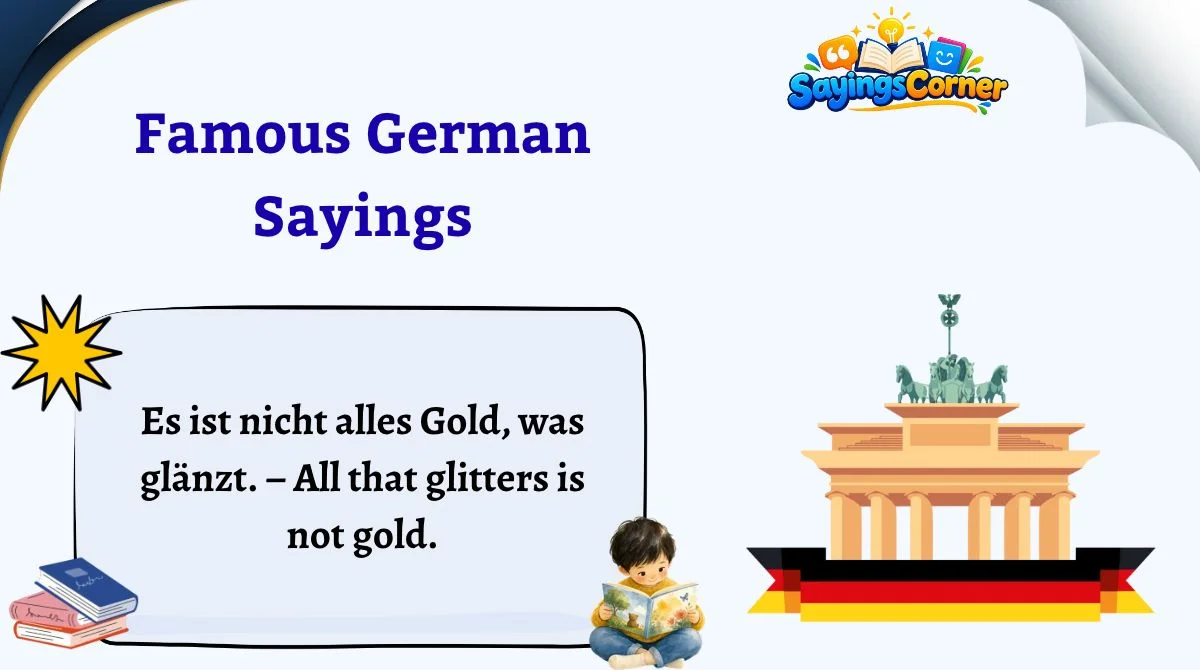
- Es ist nicht alles Gold, was glänzt. – All that glitters is not gold.
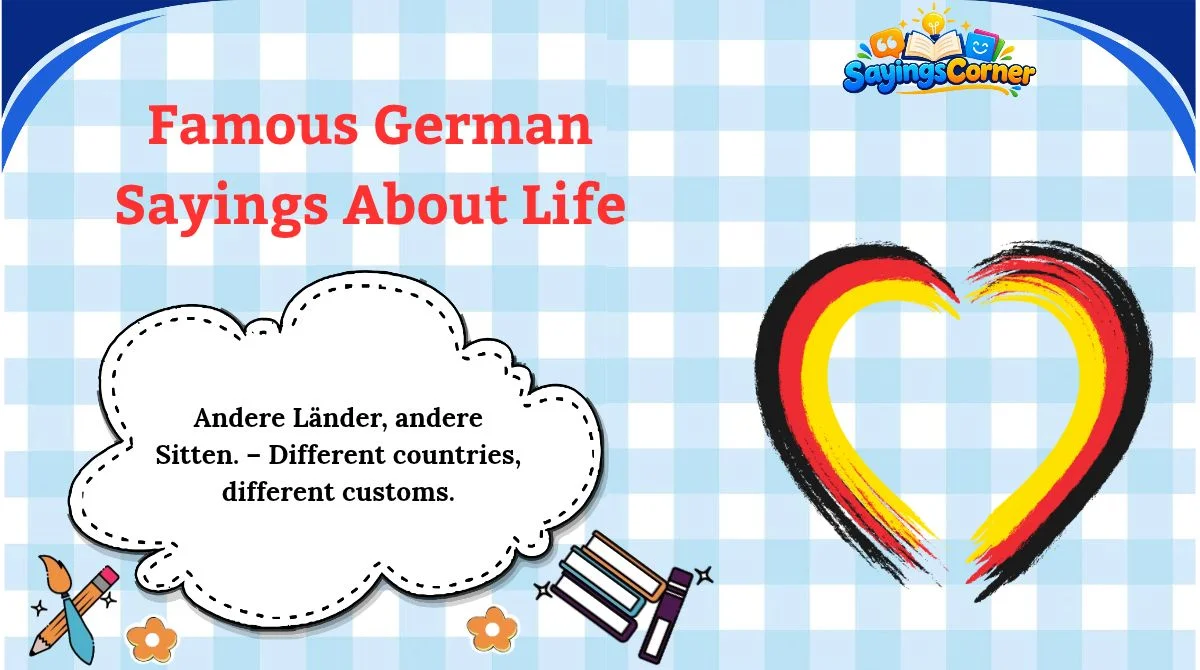
- Andere Länder, andere Sitten. – Different countries, different customs.
- Wer nicht wagt, der nicht gewinnt. – Nothing ventured, nothing gained.
- Nach Regen kommt Sonnenschein. – Sunshine comes after rain.
- Das Leben ist kein Ponyhof. – Life is not always easy.
- Man muss das Leben nehmen, wie es kommt. – You have to take life as it comes.
These sayings remind us that life has both good and bad moments. They encourage us to accept change, take chances, and make the most of our time.
Famous German Proverbs About Wisdom
Wisdom comes from experience, mistakes, and learning new things. German proverbs often teach people to think before acting and make better choices. These sayings are short but carry valuable messages.
- Reden ist Silber, Schweigen ist Gold. – Speech is silver, silence is golden.
- Irren ist menschlich. – To err is human.
- Lügen haben kurze Beine. – Lies have short legs.
- Wer anderen eine Grube gräbt, fällt selbst hinein. – Whoever digs a pit for others falls into it themselves.
- Hochmut kommt vor dem Fall. – Pride comes before a fall.
- Gut Ding will Weile haben. – Good things take time.
- Morgenstund hat Gold im Mund. – The early bird catches the worm.
- Der Klügere gibt nach. – The wiser person gives in.
- Was du nicht willst, das man dir tu, das füg auch keinem andern zu. – Do not do to others what you would not want done to you.
- Wer einmal lügt, dem glaubt man nicht, und wenn er auch die Wahrheit spricht. – Once a liar, not believed even when telling the truth.
These expressions teach honesty, patience, kindness, and humility. They are useful reminders when making decisions or dealing with other people.
Famous German Sayings About Love
Love is a special part of life, and German expressions can describe its joy, pain, and beauty. Some sayings talk about the power of love, while others remind us that true feelings are not always easy to explain.
- Liebe geht durch den Magen. – The way to someone’s heart is through their stomach.
- Liebe macht blind. – Love is blind.
- Wo die Liebe hinfällt. – Love can happen anywhere.
- Alte Liebe rostet nicht. – Old love never dies.
- Gegensätze ziehen sich an. – Opposites attract.
- Liebe kennt keine Grenzen. – Love knows no boundaries.
- Wahre Liebe wartet. – True love waits.
- Liebe ist stärker als Hass. – Love is stronger than hate.
- Geteilte Freude ist doppelte Freude. – Shared joy is double joy.
- Aus den Augen, aus dem Sinn. – Out of sight, out of mind.
Some of these are common expressions rather than uniquely German proverbs. Still, they are useful for talking about relationships, feelings, and the many sides of love.
Famous German Sayings About Friendship and Family
Friends and family make life better. They support us during hard times and celebrate our happy moments. German sayings about relationships remind us to value good people and treat others with care.
- Ein Freund in der Not ist ein Freund in der Tat. – A friend in need is a friend indeed.
- Blut ist dicker als Wasser. – Blood is thicker than water.
- Gleich und Gleich gesellt sich gern. – Birds of a feather flock together.
- Wie der Vater, so der Sohn. – Like father, like son.
- Der Apfel fällt nicht weit vom Stamm. – The apple does not fall far from the tree.
- Kleine Geschenke erhalten die Freundschaft. – Small gifts keep friendship alive.
- Freunde erkennt man in der Not. – You recognize your friends in times of need.
- Eine Hand wäscht die andere. – One hand washes the other.
- Geteiltes Leid ist halbes Leid. – Shared sorrow is half the sorrow.
- Man kann nicht jeden mögen. – You cannot like everyone.
These sayings remind us that strong relationships need love, trust, and support. They also show why true friends are so valuable.
Famous German Sayings About Hard Work and Success
Success rarely comes without effort. German proverbs often encourage people to work hard, keep learning, and never give up. These sayings are perfect for students, workers, and anyone chasing a dream.
- Übung macht den Meister. – Practice makes perfect.
- Ohne Fleiß kein Preis. – No pain, no gain.
- Wer rastet, der rostet. – Use it or lose it.
- Aller Anfang ist schwer. – Every beginning is difficult.
- Gut Ding braucht Weile. – Good things take time.
- Es ist noch kein Meister vom Himmel gefallen. – Nobody becomes a master overnight.
- Was du heute kannst besorgen, das verschiebe nicht auf morgen. – Never put off until tomorrow what you can do today.
- Viele Wege führen nach Rom. – All roads lead to Rome.
- Steter Tropfen höhlt den Stein. – Constant dripping wears away the stone.
- Wer A sagt, muss auch B sagen. – If you start something, you must see it through.
These sayings teach us that progress takes time. Small steps, regular practice, and hard work can lead to great results.
Funny and Popular German Sayings
German sayings are not always serious. Some are funny, playful, or full of humor. They are often used in everyday conversations to make people laugh or describe unusual situations.
- Das ist nicht mein Bier. – That’s not my problem.
- Tomaten auf den Augen haben. – To have tomatoes on your eyes (to fail to notice something obvious).
- Da liegt der Hund begraben. – That’s the heart of the matter.
- Jetzt geht’s um die Wurst. – Now it’s getting serious.
- Ich verstehe nur Bahnhof. – It’s all Greek to me.
- Die Kirche im Dorf lassen. – Don’t get carried away.
- Schwein haben. – To be lucky.
- Jemandem einen Bären aufbinden. – To pull someone’s leg or tell them a tall tale.
- Um den heißen Brei herumreden. – To beat around the bush.
- Das ist mir Wurst. – I don’t care.
These expressions are fun because their literal translations can sound strange in English. Their real meanings make more sense when you understand the situation in which people use them.
Famous German Sayings About Time and Patience
Time is valuable, and patience can help us achieve many things. German sayings often remind us not to rush important decisions. They also teach us to use our time wisely.
- Zeit ist Geld. – Time is money.
- Kommt Zeit, kommt Rat. – Time will tell.
- Was lange währt, wird endlich gut. – All’s well that ends well.
- Eile mit Weile. – Make haste slowly.
- In der Ruhe liegt die Kraft. – There is strength in calmness.
- Alles zu seiner Zeit. – Everything in its own time.
- Die Zeit heilt alle Wunden. – Time heals all wounds.
- Besser spät als nie. – Better late than never.
- Rom wurde auch nicht an einem Tag erbaut. – Rome wasn’t built in a day.
- Wer zu spät kommt, den bestraft das Leben. – Life punishes those who arrive too late.
These sayings encourage patience and remind us that good things often need time. They are also helpful when someone feels stressed or wants everything to happen quickly.
Famous German Sayings About Luck and Happiness
Everyone wants to be happy and enjoy good fortune. German expressions about luck teach us to appreciate small blessings, stay hopeful, and remember that happiness can come in many forms.
- Jeder ist seines Glückes Schmied. – Everyone makes their own luck.
- Glück im Unglück. – A blessing in disguise.
- Pech im Spiel, Glück in der Liebe. – Unlucky in games, lucky in love.
- Das Glück ist mit den Mutigen. – Fortune favors the brave.
- Kleinvieh macht auch Mist. – Every little bit counts.
- Wenn eine Tür zugeht, geht eine andere auf. – When one door closes, another opens.
- Man muss auch mal Glück haben. – Sometimes you just need a bit of luck.
- Geteilte Freude ist doppelte Freude. – Shared happiness is double happiness.
- Jeder ist seines Glückes eigener Schmied. – Everyone shapes their own happiness.
- Wer die Wahl hat, hat die Qual. – Having a choice can make things difficult.
These expressions remind us that happiness is not always about money or success. Sometimes, it comes from good friends, small wins, and a positive attitude.
German Sayings With English Meanings
Learning German sayings is easier when you can compare the German words with their English meanings. The table below highlights some popular expressions and explains when you can use them.
| German Saying | English Meaning | Suitable Use |
|---|---|---|
| Übung macht den Meister | Practice makes perfect | Learning a skill |
| Liebe macht blind | Love is blind | Talking about love |
| Zeit ist Geld | Time is money | Work and business |
| Aller Anfang ist schwer | Every beginning is difficult | Starting something new |
| Besser spät als nie | Better late than never | Being late |
| Lügen haben kurze Beine | Lies have short legs | Talking about honesty |
| Wer rastet, der rostet | Use it or lose it | Staying active |
| Ende gut, alles gut | All’s well that ends well | A happy ending |
| Morgenstund hat Gold im Mund | The early bird catches the worm | Getting up early |
| Viele Köche verderben den Brei | Too many cooks spoil the broth | Group work |
This table is a useful reference for German learners. You can save it and practice using these expressions in your daily conversations.
How to Use German Sayings in Everyday Life
German sayings can make your conversations more interesting. They can also help you understand German culture and communicate your thoughts in a simple way.
Here are some easy tips for using them correctly:
- Learn the real meaning: Do not depend only on the English translation. Some German sayings have meanings that are different from their literal words.
- Understand the situation: Use a saying that matches the topic. For example, “Übung macht den Meister” works well when someone is learning a new skill.
- Practice pronunciation: Read each saying aloud to become more comfortable with German sounds.
- Start with short sayings: Expressions like “Zeit ist Geld” and “Besser spät als nie” are easy to remember.
- Use them in conversations: Try adding one German saying when talking with friends or classmates.
- Learn the culture: Understanding when and why people use a saying can help you speak more naturally.
- Avoid using too many: One suitable saying is often better than several expressions in the same conversation.
The best way to remember German sayings is to practice them regularly. Choose a few favorites and try using them in real situations.
Frequently Asked Questions
1. What Is the Most Famous German Saying?
“Übung macht den Meister” is one of the best-known German sayings. It means “Practice makes perfect.” People use it to encourage someone who is learning a new skill. It reminds us that success comes from patience, effort, and regular practice.
2. What Is a Popular German Saying About Life?
“Jeder ist seines Glückes Schmied” is a popular German saying about life. It means “Everyone is the maker of their own fortune.” The message is simple: our choices and actions play an important role in shaping our future.
3. What Is a Funny German Saying?
“Ich verstehe nur Bahnhof” is a funny German expression. Its literal meaning is “I only understand train station.” However, people use it to say they do not understand something at all. It is a playful way to express confusion.
4. What Does “Liebe Macht Blind” Mean?
“Liebe macht blind” means “Love is blind.” It describes how strong feelings can make people overlook someone’s mistakes or bad qualities. People often use this expression when talking about romance, relationships, and the power of love.
5. What Is the German Word for a Proverb?
The German word for a proverb is “Sprichwort.” The plural form is “Sprichwörter.” These are short expressions that share advice, wisdom, or lessons about life. German speakers use them in everyday conversations and written communication.
Conclusion
Famous German sayings are a wonderful way to learn about German language, culture, and everyday life.
They share useful lessons about love, friendship, success, happiness, and patience. Some are wise and meaningful, while others are funny and easy to remember.
Whether you are learning German or searching for inspiring words, these expressions can help you understand the language in a deeper way.
Choose your favorite sayings, learn their meanings, and use them in your daily conversations.

Lucas Whitmore is a passionate writer who loves exploring funny sayings, timeless wisdom, and meaningful words about life. Through SayingsCorner, he shares memorable expressions that inspire smiles, spark reflection, and bring people closer together.