
English is full of common sayings that people use every day. But did you know that many people say these phrases the wrong way?
Some people change a word, leave out an important part, or mix two different expressions together. These small mistakes can change the meaning of a saying.
Learning the correct versions can help you speak and write better English. It can also help you understand what other people really mean.
In this article, you will find common sayings that people get wrong, their correct forms, and simple explanations. You will also learn how to use them in everyday conversations.
Quick Answer
Many common English sayings are often misquoted or misunderstood. For example, people say “I could care less” when they mean “I couldn’t care less.” Other examples include “nip it in the bud” and “escape goat.” Learning the correct wording helps you avoid mistakes and communicate clearly.
1. Common Sayings People Often Misquote

Some sayings sound right even when one or two words are missing. These examples show the correct versions and the mistakes people often make.
– Correct: I couldn’t care less.
Wrong: I could care less.
The correct version means you do not care at all.
– Correct: Nip it in the bud.
Wrong: Nip it in the butt.
It means to stop a problem before it grows.
– Correct: For all intents and purposes.
Wrong: For all intensive purposes.
It means in nearly every important way.
– Correct: A tough row to hoe.
Wrong: A tough road to hoe.
It describes a difficult task or challenge.
– Correct: Case in point.
Wrong: Case and point.
It introduces an example that supports an idea.
– Correct: Whet your appetite.
Wrong: Wet your appetite.
It means to make someone interested in something.
– Correct: One and the same.
Wrong: One in the same.
It means two things are actually identical.
– Correct: Free rein.
Wrong: Free reign.
It means having full freedom to make choices.
– Correct: Make do.
Wrong: Make due.
It means to manage with what you have.
– Correct: By and large.
Wrong: By in large.
It means generally or for the most part.
2. Sayings People Get Wrong Because of Similar Sounds
Some English words sound almost the same. This makes it easy to mix them up when speaking or writing.
– Correct: Bated breath.
Wrong: Baited breath.
It means waiting with great excitement or worry.
– Correct: Deep-seated.
Wrong: Deep-seeded.
It describes a strong feeling or belief that is hard to change.
– Correct: Pique someone’s interest.
Wrong: Peak someone’s interest.
It means to make someone curious.
– Correct: Old wives’ tale.
Wrong: Old wise tale.
It means a traditional belief that may not be true.
– Correct: Beck and call.
Wrong: Beckon call.
It means being ready to help someone whenever they ask.
– Correct: Sneak peek.
Wrong: Sneak peak.
It means a quick or early look at something.
– Correct: All ears.
Wrong: All years.
It means listening carefully.
– Correct: Hair of the dog.
Wrong: Hare of the dog.
It refers to a drink some people believe helps with a hangover.
– Correct: Just deserts.
Wrong: Just desserts.
It means getting what someone deserves, good or bad.
– Correct: Hail of a time.
Wrong: Hale of a time.
The standard expression is actually a whale of a time, meaning a very enjoyable experience.
3. Common Sayings With Missing or Extra Words
Sometimes people add words that do not belong or leave out words that make the saying complete.
– Correct: Curiosity killed the cat.
Common extension: Curiosity killed the cat, but satisfaction brought it back.
The shorter version warns against asking too many questions. The longer version adds a playful idea.
– Correct: Blood is thicker than water.
Common extension: The blood of the covenant is thicker than the water of the womb.
The extended version is often shared online, but claims about it being the original saying are disputed.
– Correct: Great minds think alike.
Common extension: Great minds think alike, though fools seldom differ.
The extra words add a humorous warning about having the same opinion.
– Correct: Practice makes perfect.
Common variation: Practice makes permanent.
The second version reminds us that repeating mistakes can make them harder to fix.
– Correct: You can’t have your cake and eat it too.
Wrong: You can’t eat your cake and have it too.
Both forms are used, but the first is the more familiar version today.
– Correct: The proof is in the pudding.
Older full form: The proof of the pudding is in the eating.
It means you must test something to know if it works.
– Correct: Birds of a feather flock together.
Common shortened form: Birds of a feather.
The full saying means people with similar interests often spend time together.
– Correct: A watched pot never boils.
Common variation: A watched pot never boils.
This saying is already complete. It means waiting impatiently makes time feel slower.
– Correct: Every cloud has a silver lining.
Common variation: There’s a silver lining to every cloud.
Both forms express the idea that something good can come from a difficult situation.
– Correct: The early bird catches the worm.
Common variation: The early bird gets the worm.
Both are commonly used to suggest that acting early can bring rewards.
4. Sayings People Mix Up With Other Expressions
Some mistakes happen when people combine two different sayings. This creates a new phrase that sounds familiar but is not the standard expression.
– Correct: You can’t judge a book by its cover.
Mixed version: You can’t judge a book by its pages.
The correct saying reminds us not to judge people by appearance.
– Correct: It’s a dog-eat-dog world.
Mixed version: It’s a doggy-dog world.
The correct phrase describes a competitive and sometimes cruel world.
– Correct: The whole nine yards.
Mixed version: The whole nine miles.
It means everything or the complete amount.
– Correct: If worse comes to worst.
Mixed version: If worst comes to worst.
It refers to a situation becoming as bad as possible.
– Correct: You made your bed, now lie in it.
Mixed version: You made your bed, now sleep in it.
The saying means you must accept the results of your choices.
– Correct: Don’t throw the baby out with the bathwater.
Mixed version: Don’t throw the baby out with the bathtub.
It warns against removing something useful while getting rid of something bad.
– Correct: Put the cart before the horse.
Mixed version: Put the horse before the cart.
The correct saying describes doing things in the wrong order.
– Correct: The straw that broke the camel’s back.
Mixed version: The last straw that broke the camel.
It describes a small final problem that makes a difficult situation unbearable.
– Correct: A blessing in disguise.
Mixed version: A blessing in the skies.
It means something that seems bad at first but turns out well.
– Correct: Burn the midnight oil.
Mixed version: Burn the midnight candle.
It means staying up late to work or study.
5. Sayings That People Often Misunderstand

Not every mistake involves the words themselves. Sometimes people use a saying without understanding what it really means.
– The exception proves the rule: An exception can suggest that a general rule exists. It does not simply mean that every rule has exceptions.
– Blood is thicker than water: It is commonly used to suggest that family relationships are stronger than other relationships.
– The customer is always right: This is often used to support good customer service, but it does not mean customers can never be wrong.
– Money is the root of all evil: The fuller biblical wording refers to the love of money, not money itself.
– Absence makes the heart grow fonder: Being apart from someone can make you miss them more.
– Familiarity breeds contempt: Spending too much time around someone or something can sometimes lead to irritation or a loss of respect.
– Too many cooks spoil the broth: Too many people trying to control one task can make the result worse.
– The grass is always greener on the other side: People often believe others have a better life, even when that may not be true.
– Don’t count your chickens before they hatch: Do not celebrate success before it actually happens.
– A little knowledge is a dangerous thing: Knowing only a small amount about something can lead to poor decisions.
6. Everyday Examples of Common Saying Mistakes
Here are five simple examples showing how to use these sayings correctly in everyday conversations.
Example 1: I Couldn’t Care Less
Wrong: I could care less about the argument.
Correct: I couldn’t care less about the argument.
Meaning: You do not care about it at all.
Example 2: Nip It in the Bud
Wrong: We need to nip this problem in the butt.
Correct: We need to nip this problem in the bud.
Meaning: Stop the problem before it gets bigger.
Example 3: Free Rein
Wrong: The children have free reign to choose their games.
Correct: The children have free rein to choose their games.
Meaning: They have the freedom to decide.
Example 4: Sneak Peek
Wrong: Can I have a sneak peak at your new design?
Correct: Can I have a sneak peek at your new design?
Meaning: Can I have a quick look?
Example 5: For All Intents and Purposes
Wrong: For all intensive purposes, the project is finished.
Correct: For all intents and purposes, the project is finished.
Meaning: The project is basically complete.
7. Short Conversations Using Correct Sayings
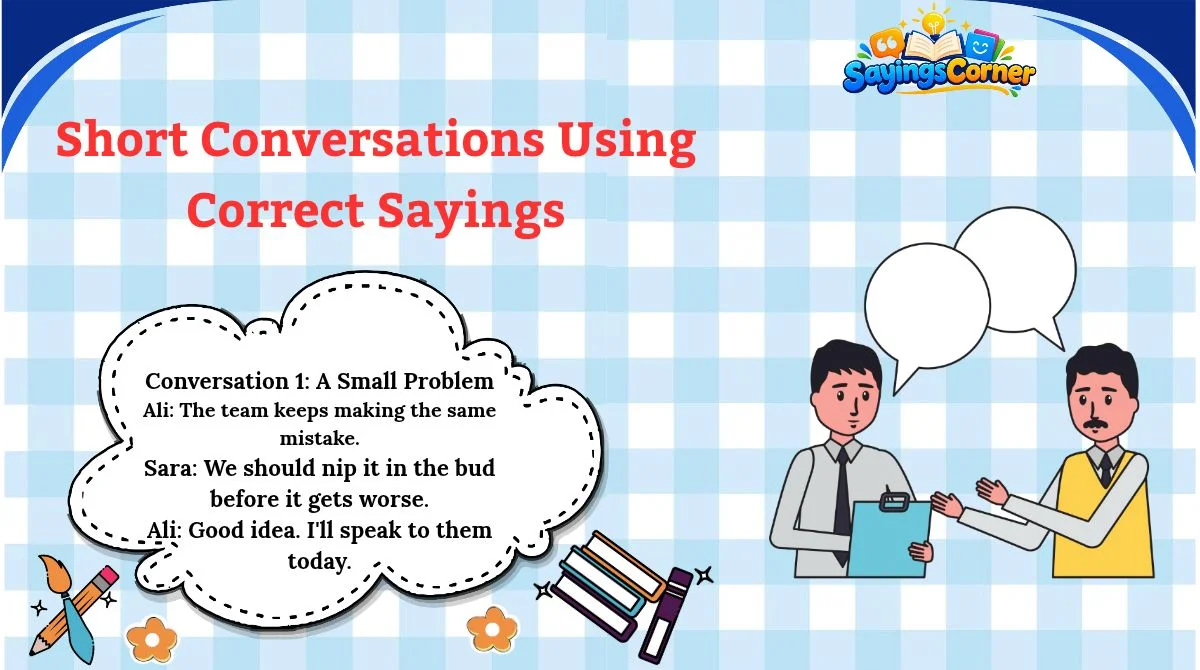
These short conversations show how common sayings fit naturally into daily speech.
Conversation 1: A Small Problem
Ali: The team keeps making the same mistake.
Sara: We should nip it in the bud before it gets worse.
Ali: Good idea. I’ll speak to them today.
Conversation 2: A New Surprise
Emma: I heard you are working on a new website.
John: Yes! Would you like a sneak peek?
Emma: Of course! I can’t wait to see it.
John: I’ll show you the design after lunch.
8. Common Sayings, Their Meanings, and When to Use Them
This table gives you a quick way to remember some frequently misquoted expressions and their correct meanings.
| Correct Saying | Simple Meaning | Suitable Use |
|---|---|---|
| I couldn’t care less | I do not care at all | Showing no interest |
| Nip it in the bud | Stop a problem early | Preventing trouble |
| Free rein | Full freedom | Giving someone choices |
| Bated breath | Waiting excitedly | Waiting for news |
| Deep-seated | Strong and deeply rooted | Describing feelings |
| Whet your appetite | Make you interested | Food or entertainment |
| Make do | Manage with what you have | Difficult situations |
| Sneak peek | A quick look | Seeing something early |
| Case in point | A supporting example | Explaining an idea |
| The whole nine yards | Everything | Giving your full effort |
9. How to Use Common Sayings Correctly
Learning the right words is only the first step. You should also know when and how to use these expressions. Here are some easy tips to help you.
– Learn the complete phrase: Do not remember only half of a saying. Learn the full expression so you do not miss important words.
– Understand the meaning: Knowing what a saying means helps you use it in the right situation.
– Check confusing words: If two words sound alike, check their spelling and meaning before using them.
– Read English books: Books, articles, and stories can help you see how people use common sayings.
– Listen to native speakers: Watch English videos and pay attention to everyday expressions.
– Practice in sentences: Write your own examples using each saying. This makes it easier to remember.
– Avoid forced expressions: Do not use a saying in every conversation. Use it only when it fits naturally.
– Check unfamiliar phrases: When you hear a strange expression, look it up in a trusted dictionary.
– Learn one saying at a time: Trying to remember too many expressions at once can be confusing.
– Review your mistakes: Keep a small list of sayings you often get wrong and check it from time to time.
Frequently Asked Questions
1. Why do people get common sayings wrong?
People often hear sayings without reading them. Over time, they may change words, mix similar expressions, or remember the wrong version. Repeating these mistakes can make an incorrect phrase sound normal, even when the original wording is different.
2. What is the most commonly misquoted saying?
“I could care less” is one of the most discussed examples. The intended expression is usually “I couldn’t care less.” The correct version clearly means that someone has no interest or concern about something.
3. Is it wrong to change the words in a saying?
Changing the words can change the meaning or make the expression less clear. However, some sayings have accepted variations. The best choice is to learn the common form and understand when other versions are used.
4. How can I remember the correct versions of sayings?
Read the correct phrases, write them in your own sentences, and practice using them in conversations. You can also keep a list of expressions you often confuse. Regular practice will help you remember them more easily.
5. Do people still use old English sayings today?
Yes! Many old sayings are still used in everyday conversations, books, movies, and social media. They help people share advice, explain situations, and express feelings in a short and memorable way.
Conclusion
Common sayings make English more interesting, but small mistakes can change their meaning.
Phrases like “I couldn’t care less,” “nip it in the bud,” and “free rein” are easy to mix up if you do not know their correct forms.
By learning their meanings and practicing them in everyday sentences, you can avoid common errors and improve your English.
Keep checking unfamiliar expressions, and soon you will feel more confident using these sayings in both speaking and writing.

Lucas Whitmore is a passionate writer who loves exploring funny sayings, timeless wisdom, and meaningful words about life. Through SayingsCorner, he shares memorable expressions that inspire smiles, spark reflection, and bring people closer together.