Spanish is full of beautiful, funny, wise, and meaningful sayings. Many of these expressions share lessons about life, love, friendship, family, and hard work.
Some are short and simple, while others use humor to teach an important lesson. If you are learning Spanish or want to understand Spanish culture, these sayings are a great place to start.
In this collection, you will find 100 common Spanish sayings with their English meanings. Each saying is easy to understand and useful in everyday conversations.
You can use them to share advice, express your feelings, make someone smile, or learn more about the Spanish language.
From popular proverbs to simple expressions, these Spanish sayings offer something for everyone.
Quick Answer
Common Spanish sayings are short expressions that share wisdom, humor, and life lessons. Popular examples include “Más vale tarde que nunca” (Better late than never), “El tiempo es oro” (Time is gold), and “No hay mal que por bien no venga” (Every cloud has a silver lining). These sayings are useful in daily conversations.
1. Common Spanish Sayings About Life
Life teaches us many lessons. Spanish sayings often remind us to stay strong, enjoy the present, and learn from our experiences. Here are some popular expressions about life.
- La vida es corta. — Life is short.
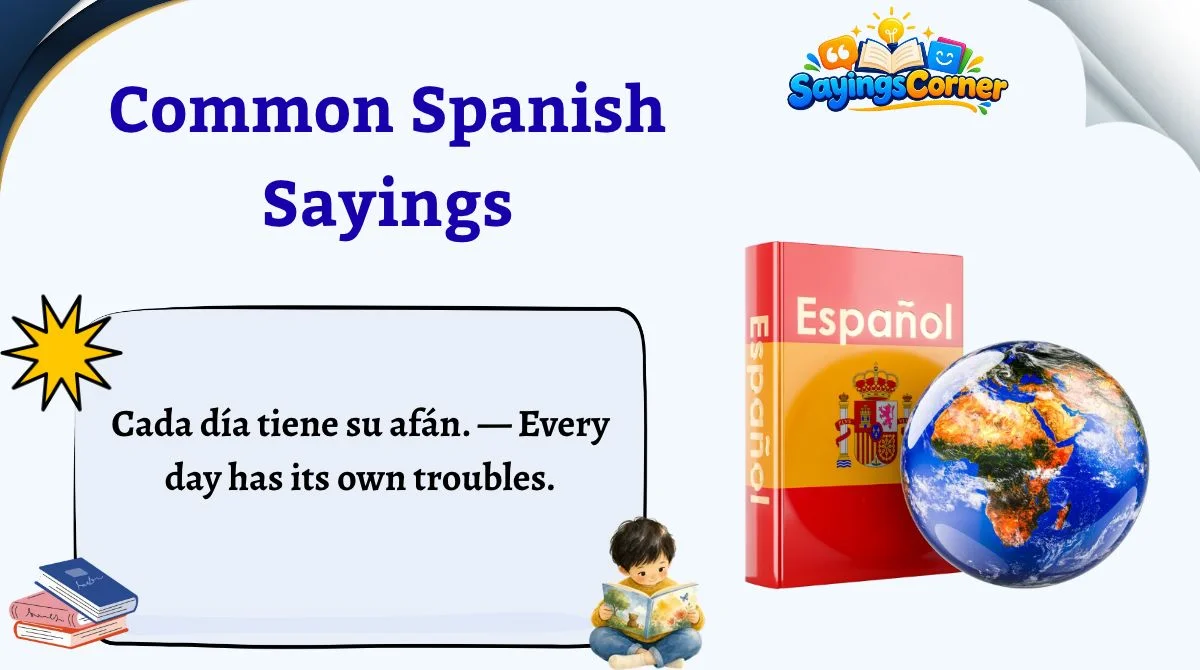
- Cada día tiene su afán. — Every day has its own troubles.
- El tiempo lo cura todo. — Time heals everything.
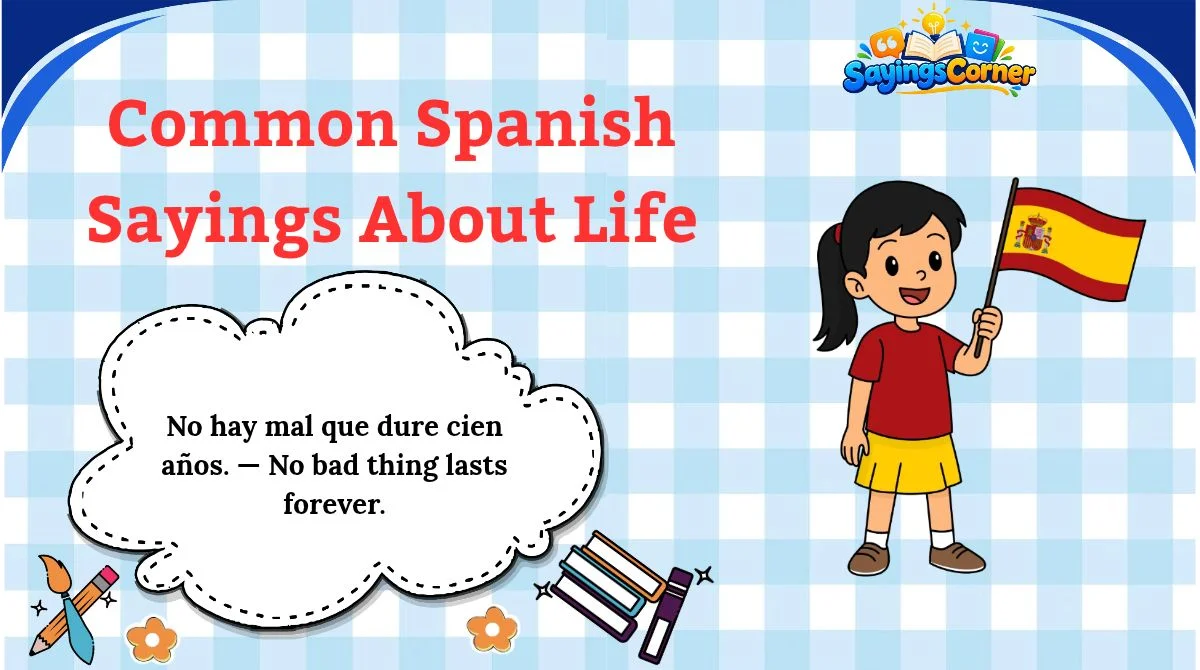
- No hay mal que dure cien años. — No bad thing lasts forever.
- Vive y deja vivir. — Live and let live.
- La vida sigue. — Life goes on.
- Nunca es tarde para empezar. — It is never too late to start.
- Después de la tormenta viene la calma. — After the storm comes calm.
- Todo pasa por algo. — Everything happens for a reason.
- Al mal tiempo, buena cara. — Put on a brave face in hard times.
These sayings remind us that life has both good and bad moments. They encourage patience, hope, and a positive attitude.
2. Spanish Sayings About Love and Relationships
Love is an important part of life. Spanish expressions about love can be sweet, wise, or even a little funny. Use these sayings to express feelings or share relationship advice.
- El amor todo lo puede. — Love can overcome anything.
- Ojos que no ven, corazón que no siente. — What the eye doesn’t see, the heart doesn’t feel.
- El amor es ciego. — Love is blind.
- Amor con amor se paga. — Love is repaid with love.
- Donde hay amor, hay vida. — Where there is love, there is life.
- Quien bien te quiere, te hará llorar. — Someone who truly cares about you may sometimes tell you hard truths.
- Amar es compartir. — To love is to share.
- El corazón tiene razones que la razón no entiende. — The heart has reasons that reason cannot understand.
- Contigo, pan y cebolla. — With you, even bread and onions are enough.
- Más vale solo que mal acompañado. — Better alone than in bad company.
These expressions show that love is about care, trust, and understanding. They also remind us that a healthy relationship is worth more than simply being with someone.
3. Spanish Sayings About Friendship
Good friends make life better. They support us during hard times and celebrate our happy moments. These Spanish sayings share lessons about choosing friends and building strong friendships.
- Quien tiene un amigo, tiene un tesoro. — Whoever has a friend has a treasure.
- Dime con quién andas y te diré quién eres. — Tell me who you walk with, and I’ll tell you who you are.
- En la necesidad se conoce al amigo. — A friend in need is a friend indeed.
- Amigos pocos y buenos. — Few friends, but good ones.
- Las amistades verdaderas duran para siempre. — True friendships last forever.
- Un buen amigo vale más que mil conocidos. — A good friend is worth more than a thousand acquaintances.
- La amistad no tiene precio. — Friendship has no price.
- Los amigos están en las buenas y en las malas. — Friends are there in good times and bad.
- Quien encuentra un amigo encuentra un tesoro. — Whoever finds a friend finds a treasure.
- Un amigo es un hermano elegido. — A friend is a chosen brother.
These sayings remind us that true friendship is built on loyalty, honesty, and support. A small circle of good friends can mean more than a large group of people.
4. Spanish Proverbs About Wisdom and Learning
Wisdom comes from experience, mistakes, and careful thinking. Spanish proverbs often teach us to make good choices and think before we act.
- Más sabe el diablo por viejo que por diablo. — The devil knows more because he is old than because he is the devil.
- El saber no ocupa lugar. — Knowledge takes up no space.
- Nunca te acostarás sin saber una cosa más. — You never go to bed without learning one more thing.
- A palabras necias, oídos sordos. — Turn a deaf ear to foolish words.
- La experiencia es la madre de la ciencia. — Experience is the mother of knowledge.
- Piensa antes de hablar. — Think before you speak.
- El que mucho abarca, poco aprieta. — Whoever tries to do too much accomplishes little.
- No todo lo que brilla es oro. — All that glitters is not gold.
- Más vale prevenir que curar. — Prevention is better than cure.
- Rectificar es de sabios. — Correcting yourself is a sign of wisdom.
These expressions encourage us to keep learning, listen carefully, and avoid making quick decisions. They are useful when giving advice to friends, family, or children.
5. Funny and Humorous Spanish Sayings
Spanish has many expressions that use humor to describe everyday situations. Some make fun of bad luck, while others remind us not to take life too seriously.
- A falta de pan, buenas son tortas. — When there is no bread, cakes will do.
- El que ríe último, ríe mejor. — He who laughs last, laughs best.
- Más vale maña que fuerza. — Skill is better than strength.
- Cada loco con su tema. — Everyone has their own obsession.
- De tal palo, tal astilla. — Like father, like son.
- A otro perro con ese hueso. — Take that story somewhere else.
- No hay peor ciego que el que no quiere ver. — There is no worse blind person than someone who refuses to see.
- Cría cuervos y te sacarán los ojos. — Raise crows, and they will peck out your eyes.
- Mucho ruido y pocas nueces. — Much ado about nothing.
- El que se fue a Sevilla perdió su silla. — Whoever leaves their seat loses it.
These funny sayings are great for casual conversations. They can help you express an opinion, joke with friends, or describe a situation in a clever way.
6. Spanish Sayings About Hard Work and Success
Success takes effort, patience, and determination. These Spanish proverbs remind us that good results often come from hard work and steady action.
- El que la sigue, la consigue. — Whoever keeps trying eventually succeeds.
- A quien madruga, Dios le ayuda. — God helps those who get up early.
- Poco a poco se llega lejos. — Little by little, you go far.
- La práctica hace al maestro. — Practice makes perfect.
- Roma no se construyó en un día. — Rome wasn’t built in a day.
- Querer es poder. — Where there is a will, there is a way.
- El trabajo dignifica. — Work gives dignity.
- Sin esfuerzo no hay recompensa. — There is no reward without effort.
- No dejes para mañana lo que puedas hacer hoy. — Don’t put off until tomorrow what you can do today.
- El que no arriesga, no gana. — Nothing ventured, nothing gained.
These sayings are useful for students, workers, business owners, and anyone chasing a dream. They remind us that progress takes time and that giving up too early can stop us from reaching our goals.
7. Spanish Sayings About Money and Happiness
Money is useful, but it is not the only thing that matters. Spanish expressions about money often teach us to value people, health, and simple pleasures.
- El dinero no da la felicidad. — Money does not bring happiness.
- El tiempo es oro. — Time is money.
- Lo barato sale caro. — Cheap things can turn out to be expensive.
- Nadie da duros a cuatro pesetas. — Nobody gives something valuable for less than it is worth.
- Más vale pájaro en mano que ciento volando. — A bird in the hand is worth two in the bush.
- A buen hambre no hay pan duro. — When you are very hungry, no bread is too hard.
- La salud es lo primero. — Health comes first.
- No es más rico quien más tiene, sino quien menos necesita. — The richest person is not the one who has the most, but the one who needs the least.
- El dinero va y viene. — Money comes and goes.
- Las mejores cosas de la vida son gratis. — The best things in life are free.
These sayings remind us to spend wisely and appreciate what we already have. Happiness often comes from good health, family, friendship, and peace of mind.
8. Spanish Sayings About Family and Everyday Life
Family plays a big role in many Spanish-speaking cultures. These expressions talk about family ties, daily habits, and the lessons we learn at home.
- La familia es lo primero. — Family comes first.
- De tal palo, tal astilla. — Like father, like son.
- Cada familia es un mundo. — Every family is a world of its own.
- En casa de herrero, cuchillo de palo. — The shoemaker’s children go barefoot.
- Madre no hay más que una. — You only have one mother.
- La unión hace la fuerza. — Unity is strength.
- Donde comen dos, comen tres. — Where two can eat, three can eat.
- El hábito no hace al monje. — Clothes do not make the person.
- A cada cerdo le llega su San Martín. — Everyone eventually gets what is coming to them.
- Cada oveja con su pareja. — Each person should find their match.
These sayings are helpful when talking about family values, shared responsibilities, and everyday experiences. They also show how Spanish expressions can describe common situations with just a few words.
9. Short and Popular Spanish Sayings
Sometimes, a few words can express a big idea. These short Spanish sayings are easy to remember and useful in daily conversations.
- Más vale tarde que nunca. — Better late than never.
- El tiempo es oro. — Time is precious.
- Todo llega. — Everything comes in time.
- Hechos son amores. — Actions speak louder than words.
- La esperanza es lo último que se pierde. — Hope is the last thing lost.
- Nunca digas nunca. — Never say never.
- Sin prisa, pero sin pausa. — Without rushing, but without stopping.
- Lo prometido es deuda. — A promise is a debt.
- A grandes males, grandes remedios. — Great problems require great solutions.
- Quien calla, otorga. — Silence gives consent.
These short expressions are easy to use in messages, social media captions, and everyday chats. They are also a good starting point for people who are learning Spanish.
10. More Common Spanish Sayings About Hope and Life Lessons
Life does not always go as planned. These final sayings offer encouragement and remind us to stay hopeful, make wise choices, and keep moving forward.
- No hay mal que por bien no venga. — Every cloud has a silver lining.
- Después de la lluvia sale el sol. — After the rain comes the sun.
- Mientras hay vida, hay esperanza. — While there is life, there is hope.
- A caballo regalado no le mires el diente. — Don’t look a gift horse in the mouth.
- Agua pasada no mueve molino. — There is no use crying over spilled milk.
- Cuando una puerta se cierra, otra se abre. — When one door closes, another opens.
- No dejes que el miedo te detenga. — Don’t let fear stop you.
- Cada paso cuenta. — Every step counts.
- Lo que no te mata te hace más fuerte. — What doesn’t kill you makes you stronger.
- El que busca, encuentra. — Whoever seeks, finds.
These sayings can bring comfort during difficult times. They remind us that setbacks are part of life and that new chances can appear when we least expect them.
Useful Spanish Sayings, Meanings, and Uses
Here is a simple table of some popular Spanish sayings, their English meanings, and situations where you can use them.
| Spanish Saying | English Meaning | Suitable Use |
|---|---|---|
| Más vale tarde que nunca | Better late than never | When someone arrives late |
| El tiempo es oro | Time is precious | When time matters |
| No todo lo que brilla es oro | All that glitters is not gold | Giving wise advice |
| La unión hace la fuerza | Unity is strength | Teamwork and family |
| Al mal tiempo, buena cara | Stay positive in hard times | Encouraging a friend |
| Más vale prevenir que curar | Prevention is better than cure | Giving safety advice |
| Querer es poder | Where there is a will, there is a way | Motivating someone |
| Ojos que no ven, corazón que no siente | What the eye doesn’t see, the heart doesn’t feel | Talking about hidden problems |
| El que no arriesga, no gana | Nothing ventured, nothing gained | Encouraging action |
| No hay mal que por bien no venga | Every cloud has a silver lining | Comforting someone |
How to Use Common Spanish Sayings in Everyday Life
Learning Spanish sayings is more than remembering words. You should also understand when and how to use them. Here are some simple tips to help you use these expressions naturally.
1. Learn the meaning first.
Always understand what a saying means before using it. Some expressions have a deeper meaning than their direct English translation.
2. Use sayings in the right situation.
For example, use “Más vale tarde que nunca” when someone finishes something late. Use “Al mal tiempo, buena cara” when encouraging someone during a difficult time.
3. Practice with native speakers.
Listen to how Spanish speakers use these expressions in real conversations. This will help you understand their tone and meaning.
4. Start with short sayings.
Expressions like “Todo llega” and “Nunca digas nunca” are simple and easy to remember. Practice using them in short sentences.
5. Avoid using too many sayings together.
One saying at the right moment can make your message stronger. Using too many expressions in one conversation may sound unnatural.
6. Learn the cultural meaning.
Some sayings use humor, old-fashioned words, or comparisons. Understanding the idea behind them will help you use them correctly.
Frequently Asked Questions
1. What is the most common Spanish saying?
“Más vale tarde que nunca” is a widely recognized Spanish saying. It means “Better late than never.” People use it when someone completes a task or arrives later than expected. It reminds us that doing something late is better than not doing it at all.
2. What are some famous Spanish proverbs about life?
Some popular Spanish proverbs about life include “Al mal tiempo, buena cara,” meaning stay positive during hard times, and “No hay mal que por bien no venga,” meaning every cloud has a silver lining. Both expressions encourage hope and a positive attitude.
3. What is a beautiful Spanish saying about love?
“Contigo, pan y cebolla” is a sweet Spanish expression about love. It means “With you, even bread and onions are enough.” It suggests that being with someone you love matters more than having money or expensive things.
4. Are Spanish sayings and Spanish proverbs the same?
They are closely related, but they are not always the same. A proverb usually shares advice or a life lesson, while a saying can be any common expression. Both are useful for understanding the Spanish language and culture.
5. How can I learn Spanish sayings easily?
Start by learning five sayings at a time. Read their English meanings, practice saying them aloud, and use them in simple conversations. Watching Spanish shows and listening to native speakers can also help you understand when these expressions are used.
Conclusion
Common Spanish sayings are a wonderful way to learn more about the Spanish language and its culture. They share lessons about love, friendship, family, money, happiness, and everyday life.
Whether you are learning Spanish or simply enjoy meaningful expressions, these 100 sayings give you plenty of ideas to explore.
Choose your favorite ones, learn their meanings, and try using them in your daily conversations.

Lucas Whitmore is a passionate writer who loves exploring funny sayings, timeless wisdom, and meaningful words about life. Through SayingsCorner, he shares memorable expressions that inspire smiles, spark reflection, and bring people closer together.